
Poaching Seafood | When liquid Becomes the Medium for Gentle Precision
It was May 2024 in La Spezia, at a trattoria on the waterfront where the tables spilled out toward the water, I ordered Ligurian Sea bass dish. What arrived sat in a pan sauce of Taggiasca olives, pine nuts, thyme, and orange – not lemon, which I hadn’t expected. That detail stopped me as all we saw in the area were lemons. The orange changed the character of the whole dish: softer acidity, a slight sweetness behind the brine of the olives. I ate it slowly and paid attention. It wasn’t technically a poached dish. But it was the first time I’d properly noticed what liquid does to fish when it’s given the chance – how the sauce had borrowed something from the fish and the fish had taken something back.
Back home, that thought stayed. The Adelaide Hills kitchen, a dry apple cider reducing in a wide pan, the smell of shallots beginning to soften in butter. I was poaching bearded rock cod – a Cape Jaffa fish from Fair Seafood, and I was nervous. Not of the fish, which I knew well enough. Of the technique. Poaching had always struck me as the method you fell back on when you didn’t trust yourself with direct heat. I’d spent years building confidence at the pan. Why hand control over to a pot of warm liquid?
That afternoon changed the question. As the bearded rock cod lifted from the liquid – opaque to the edge, barely-set at the centre, carrying the faintest echo of apple and shallot – I understood that poaching isn’t a retreat from technique. It requires a different kind of attention. Not the quick decisions of a hot pan, but the discipline to hold something steady and trust the process.
Temperature Is the Technique
Poaching sits fish in liquid – seasoned water, aromatic broth, wine-based court bouillon, cider, even milk – and that liquid does two things simultaneously: it transfers heat gently and permits flavour to move in both directions, fish into liquid and liquid into fish. The result sits somewhere pan-searing and steaming cannot reach: moist, tender fish carrying subtle complexity from whatever it cooked in, with no crust and no concentration of flavour through reduction. Just gentle heat that lets the fish’s own character lead.
The difference between poaching and boiling is entirely temperature. Boiling at 100°C with vigorous bubbles toughens fish and breaks it apart. Proper poaching holds liquid between 70-80°C, gentle movement, no surface bubbles. I use induction for this because it holds 75°C without constant adjustment. If bubbles begin to form, the heat comes down immediately. That range allows proteins to set gradually rather than seize, and I’m aiming for an internal temperature of 48-52°C depending on species, knowing carry-over cooking during rest will finish the job. I check with a probe in the thickest part, not the clock.
None of this requires a stovetop. A steam oven or combi oven set to the same 75°C will produce the same result without watching a pot. Use a solid container rather than perforated – the fish needs to sit in the liquid, not just the steam around it – and expect roughly the same 10–12 minutes for a similar thickness. The technique doesn’t belong to the cooktop.

Court Bouillon: The Foundation
Court bouillon – literally “short broth” is a seasoned liquid built specifically for poaching, quick rather than the hours a stock needs: water, white wine or vinegar for acidity, onion, celery, carrot, bay leaves, peppercorns, and herbs. I’ll simmer it for 20 minutes – the kitchen smells like the start of something good before any fish has gone near it – then strain it and let it cool to 75-80°C before the fish goes in. Boiling court bouillon shocks the exterior before the centre has time to cook, which defeats the entire purpose.
The real reward comes after. That liquid has absorbed something from the fish during cooking. Reduce it by half, mount it with cold butter and fresh herbs, and you have a sauce that actually tastes like the fish – because it borrowed that flavour while they were together in the pan.
The Cider Version
The Normandy-style poach is where I find myself returning most often – cider, shallots, cream – and it was this technique that changed my relationship with poaching entirely. I use a dry Adelaide Hills apple cider in place of the traditional Norman variety, and Tweedvale cream, because those are the right ingredients for where I live. The method is French. Everything else is local.
The liquid comes about two-thirds to three-quarters up the fish – not submerged, which is where a cartouche earns its place. Cut a circle of baking paper to fit the pan, make a small hole in the centre, and lay it directly on the surface. The hole allows a controlled amount of steam to escape and the liquid to reduce gently while the fish poaches. A tight lid does the opposite: it traps heat, pushes the liquid past poaching temperature, and takes away the visual cue of bubbles beginning to form.
For the Ōra King salmon version, I build a velouté from the poaching liquid: melt butter, make a roux, add the warm poaching liquid gradually, finish with cream and a few drops of lemon juice. The sauce tastes of Ōra King salmon and apple and shallot because it was there for all of it. For bearded rock cod with Goolwa Pipis, I reduce the poaching liquid hard before the cream goes in – usually 2-3 minutes at a brisk boil – then add the cream and reduce again until it coats the back of a spoon. The pipis are steamed separately in the same cider and folded in at the end, bringing shellfish liquor into a sauce that already carries the cod. Both techniques share the same structure. What changes is what you’re building around it.
I use Ōra King salmon specifically because its fat content gives more latitude at 75°C. A leaner fish needs more care at that temperature – the fat here forgives slight variations in timing.
Provenance Matters More Here
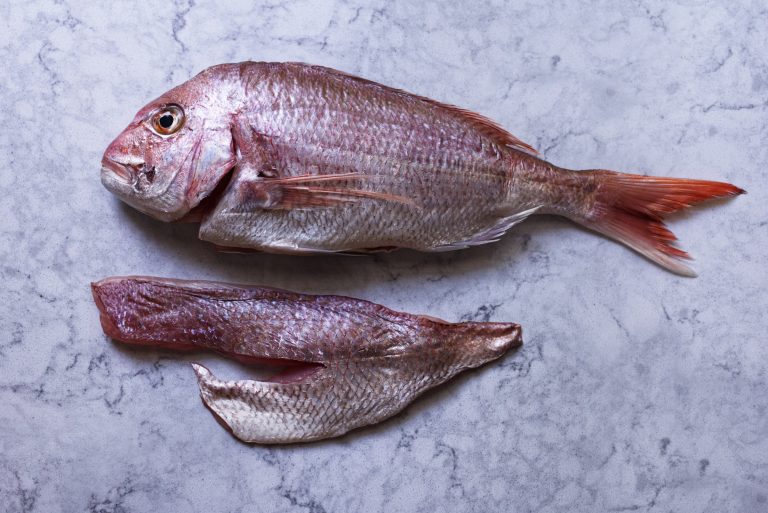
Poaching amplifies fish quality in both directions. Unlike pan-searing, where the Maillard reaction creates new flavour at the surface, poaching reveals what is already there. Poor-quality fish develops off-flavours that gentle cooking cannot disguise or cover with a crust – there is nothing to hide behind. When I pick up pink ling, coral trout, or bearded rock cod from Fair Seafood and I know exactly where it was caught and how it was handled, that context arrives on the plate in a way it simply doesn’t when the fish has been handled less carefully. This technique makes the supply chain visible.
Other Liquids Worth Knowing
Thai-style broths are where I return when I want something further from the French tradition: lemongrass, galangal, kaffir lime, ginger, fish sauce, and palm sugar hit hot stock and the character of the whole kitchen changes. This works beautifully with barramundi, coral trout, or snapper at the same 75-80°C. Reduce the liquid, add coconut cream, lime juice, and coriander, and you have a sauce that is Thai principles applied to gentle fish cookery.
Milk or cream gives remarkably tender results for delicate species like flathead or sand whiting, the dairy working without overwhelming their mild sweetness. The dual purpose is what makes it worth doing: that fish-infused milk becomes the base for a pie or chowder, so the fish has been cooked and the sauce built in one step rather than two separate jobs.
Simple salted water is sometimes all you need – when the fish is exceptional and you want nothing standing between you and its natural flavour.
Which Fish, and Why
Firmer white fish with good structure suit poaching well: pink ling, flathead, nannygai, coral trout, bearded rock cod, snapper. They hold their shape in the liquid and absorb aromatics without falling apart on the way to the plate. Medium-textured fish like barramundi work well but need gentle handling on the way out – their flesh is softer and will break if you rush it. Very delicate species like sand whiting and yellowfin whiting are better steamed, where they’re not submerged and there’s less risk of breaking during cooking.
What to Watch
Lower fish in gently with a spatula or slotted spoon – dropping it in can break the delicate flesh or splash enough to disrupt the liquid temperature. Leave space between pieces so they don’t stick together or cook unevenly. Season the liquid itself so it tastes slightly over-seasoned on its own – the fish will dilute it during cooking.
Remove the fish at 48-50°C and rest it 2-3 minutes. Carry-over cooking finishes the job without leaving it in any longer. At 48-50°C the texture is silky and barely-set – that is the distinctive poached texture. At 52–55°C it is more traditionally cooked through: opaque, still tender, less silky but more familiar. Push to 58-60°C and it is firmer – still good, but you have lost some of what made you poach it in the first place.
If 48-50°C feels too far from what you’re used to, start at 52-55°C. Once you’re comfortable, work your way down and feel the difference for yourself.
The Lesson From That Afternoon
Poaching represents a different kind of control – not the instant feedback of a hot pan, but the discipline of maintaining something stable and letting time do the work. The bearded rock cod that afternoon wasn’t the most dramatic dish I’ve made. No crust, no char, no caramelisation. Just fish, barely-set, carrying the apple and shallot it had cooked in, with a cream sauce that tasted like both. It was the right technique for that fish on that evening, and understanding when poaching is the right answer – rather than reaching for the pan by default – is what gives you real range as a cook.
I remain convinced that by staying curious and open-minded, by showing a willingness to learn and move beyond what is comfortable, you improve the chances of understanding what you are actually trying to achieve in the kitchen. Poaching taught me that restraint is a technique too. Lean in. The learning is in the doing.
Follow my journey at @AncientGrains63· ag63.au ·as I explore the species, techniques, and stories that meet the plate.