
The Restaurant Question | Why Fish Tastes Different in a Restaurant and What to Do About It at Home
At a cooking demonstration at the Adelaide Central Market, I asked the audience a simple question: how many of you prefer the fish you eat in a good restaurant to the fish you cook at home? Most hands went up. The audience was seated directly opposite the community kitchen, the noise and movement of the market carrying on behind them – stallholders, shoppers, the ordinary rhythm of a Friday morning. What struck me was that some people at nearby tables, nothing to do with the demonstration, had quietly stopped what they were doing and started listening. I included them.
The follow-up question is the one that matters: why? Most people assumed it was something about the fish itself – the quality, the freshness, the species. Some guessed the chef had a technique only professionals know. Very few pointed to the thing that actually explains it, because it’s not dramatic enough to seem like an answer. It’s time and temperature. Not exotic, not expensive. Just understood.
To make the point, I deliberately cooked two pieces at that demonstration. One overcooked – which, with a decent fillet, is harder to do than it sounds and genuinely painful to waste. One undercooked. I took both pieces around the room and asked people to feel and taste the difference. The reaction was immediate. Wow. Now I understand. That’s the moment I was after.
The Question Recipe Books Don’t Answer
I’d been cooking fish reasonably well for years before I sat down with Chef Sam at Angler in Stirling and asked him directly: why does the fish you cook taste different to mine? Not how to cook it – I had recipes. I wanted to understand the why behind the result. Recipe books and magazine articles give you steps and timings. They rarely explain what’s actually happening in the pan, or why the restaurant version arrives at the table with a texture that home cooking so often misses.
Sam explained it in a way that rearranged my thinking completely. The fish keeps cooking after you turn off the heat. If it looks done in the pan, it’s already overdone on the plate. Residual heat in the pan, the plate, the sauce – all of it continues the process. Restaurant kitchens know this and account for it. Home cooks tend not to, because no one told them the principle, only the recipe.
What 80% Actually Looks Like
When a skin-on fillet goes into a heated pan skin-side down – cast iron or heavy stainless steel, a fish weight applied immediately for even contact – you watch the flesh, not the clock. Raw fish is translucent. As heat moves up through the fillet from the skin, the flesh turns opaque. You’re waiting for roughly 80% of the fillet to have made that transition, with a thin band of translucency still visible at the top.
At that point, you turn it. One turn. The flesh side needs thirty seconds to a minute depending on thickness, then the heat goes off. The residual warmth finishes the job. What you’re left with is fish that’s just-set at the centre – the texture that made the room go quiet at the Central Market demonstration.
A probe thermometer is a useful thing to have close by, particularly when you’re working with an unfamiliar cut or building confidence with the visual cue. For delicate white fish like barramundi and similar species, you’re looking at somewhere in the range of 38-42°C internally. But the probe is a confirmation, not a substitute for understanding what you’re looking at. Once the 80% cue becomes instinct, you’ll reach for it less often.
Thickness Changes the Timing, Not the Principle
A thin fillet – garfish, a delicate reef fish, a tapered tail section — might take three to five minutes total. A fillet two centimetres thick, five to seven. A centre cut will take longer, and may benefit from two or three minutes in a 160°C oven after the initial skin-side sear rather than relying entirely on residual pan heat. The visual principle doesn’t change. The oven simply gives you more control over the carry-over in a thicker piece.
For a family meal – where you might be working with half a side rather than individual portions – a teppanyaki plate on the induction with an appropriate weight, or the oven, gives you the even heat distribution a single pan can’t manage at scale. The technique is the same. It just needs the right surface.
The Fish You Start With
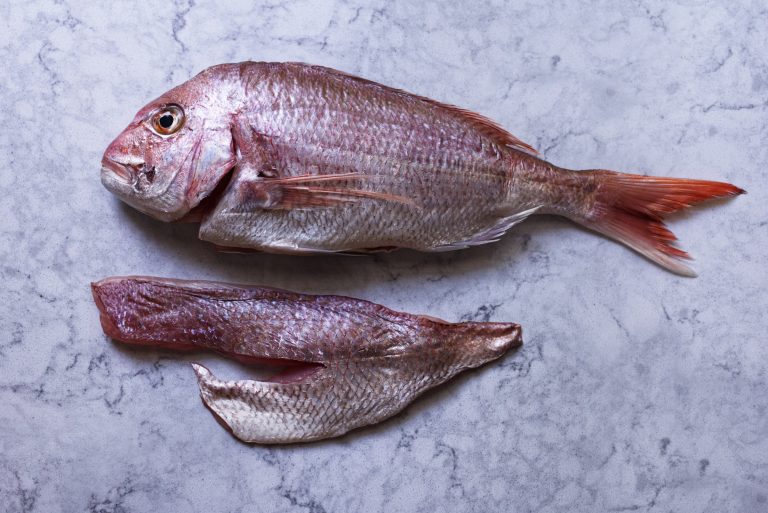
I source barramundi and other fresh local seafood from Fair Seafood – Australia’s only fully traceable fisher-to-consumer seafood supplier. The 48-72 hour water-to-plate window matters here in a practical sense: fish this fresh has the firmness and moisture the visual cue depends on. The opaque band is more readable. The texture responds to heat more predictably. You cannot rescue poor quality with a better thermometer. Provenance isn’t a story to tell after the meal — it’s a condition that determines what’s possible before you cook.
Truly fresh fish – the kind that arrived at Fair Seafood yesterday – can sit uncovered in the coolest part of your fridge for a day or two without compromising quality. Think about it the way you’d think about resting meat. The surface firms slightly, moisture evaporates, and what you’re left with is a fillet that will sear rather than steam when it hits the pan. I treat fish exactly this way: on a rack, elevated, uncovered, in the coldest section of the fridge. If you have time the night before, this step alone will change the result.
Before cooking, the fillet comes out of the fridge and rests at room temperature briefly – long enough to take the chill off, nothing more. Free of surface moisture. Pat it dry with paper towel if needed. Sea salt, a grind of white pepper. The skin should feel slightly tacky, not wet. That tackiness is what tells you the surface is ready. Moisture in the pan means steam, steam means the skin won’t crisp, and a skin that won’t crisp means you’ve already lost the best part of the cook before you’ve started.
Showing Off the Seafood
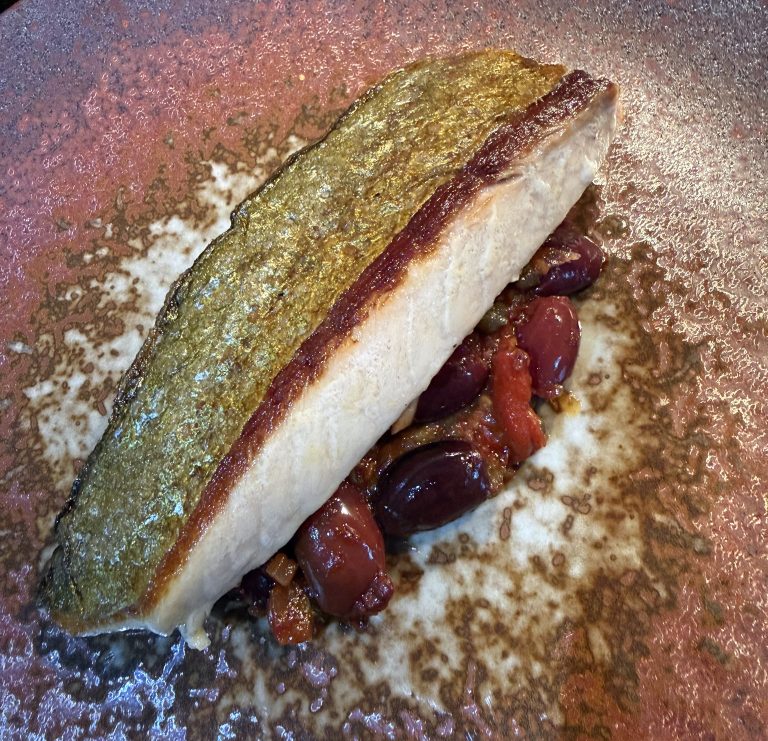
When I plate fish, the aim is to draw people in through the seafood itself – to let the quality of the ingredient and the care of the technique be the thing that stops them. On a good day, with time and intent, that might be a swirl of brown butter emulsion and finger lime pearls for acidity and textural contrast. The fish centred and uncluttered. A photograph worth taking.

On a Wednesday night it might be a pat of frozen tarragon butter or herb butter placed on the fish as it rests, melting into the flesh whilst you set the table. Both are restraint. Both let the seafood do the work. The difference is the occasion, not the principle.
That said, I’m aware of the gap between the photography and the weeknight kitchen. A home cook preparing a midweek meal isn’t standing in front of thirty plates choosing the right one. They’re feeding people, probably under some time pressure, with whatever’s to hand. The principle is the same either way – show off the seafood, don’t smother it — but the execution can be as simple as a clean white plate. Restraint on the plate mirrors restraint in the cooking. Neither requires equipment you don’t have.
I remain convinced that by staying curious and open-minded, by showing a willingness to learn and move beyond your comfort zone, it will help improve the chances of understanding what you are actually trying to achieve in the kitchen. The technique refines itself through repetition. Those two pieces at the Central Market – one overdone, one under – taught that room more in five minutes than a recipe card would have managed in a year. This is the art of hiding art. The technique should be invisible. What people experience is simply good food, honestly presented.
What’s your go-to approach for fish at home – the visual cue, the clock, or a probe? Have you tried turning off the heat and letting the pan finish the work? I’d love to know what clicked for you once the principle made sense. Let me know below.
This is Part One of the series. Now that the principle is in place – temperature, timing, the 80% cue – Part Two goes into the detail of species-specific pan technique. Barramundi cooks differently to kingfish, mulloway, or a whole garfish on the bone. Each species has its own requirements, its own visual cues, its own moment to pull from the heat. Understanding the why first makes the how considerably easier to absorb.
Follow my journey at AncientGrains63 as I explore traceable Australian seafood species by species – and how understanding what each fish needs transforms a good result into a consistent one.
#AustralianSeafood #FairSeafood #CookingTechnique #Barramundi #SandWhiting #SimpleFoodHonestlyPresented #AdelaideFood #SustainableSeafood #CentralMarket #FoodProvenance